
There’s More to Being a Safety Cop Than You Think
There’s More to Being a Safety Cop Than You Think
Traditionally, we think of a safety cop as someone who shows up on a jobsite, points out everything that’s wrong, writes people up, and leaves. That is one kind of safety cop. But that is not the safety cop I’m addressing in my book, Stop Being the Safety Cop.
I’m talking about the safety professional who takes control of situations that belong to operations. This person may be respected and knowledgeable, with a genuine desire to help. Over time, they begin directing employees and making operational decisions instead of supporting the supervisors responsible for the work.
The Safety Cop Who Means Well
In the opening chapter of my book, I describe a foreman who sees an employee failing to follow a known PPE requirement. Rather than address the employee, the foreman waits because the safety professional is nearby. Safety steps in, corrects the behavior, and everyone goes back to work.
The immediate issue has been handled, but the foreman has handed off a responsibility that belongs to him. The employee has also seen safety, rather than the foreman, take charge of the correction.
When that pattern repeats, operations begins relying on safety to handle matters it should manage. The safety professional may become frustrated by the lack of ownership without recognizing how their own actions helped create the dependency.
We Don’t Manage the Crew
A superintendent manages the project. Foremen direct their crews and decide how tasks will be performed. Those decisions carry safety consequences, which is precisely why operational leaders must retain responsibility for them.
Safety professionals bring technical knowledge that helps supervisors recognize exposures and understand applicable requirements. We should challenge decisions when necessary and provide guidance when a situation requires expertise beyond the supervisor’s knowledge.
There are circumstances when immediate intervention is necessary. If an employee faces a serious and immediate exposure, protecting that person takes priority. We also have a responsibility to challenge inadequate responses and escalate unresolved concerns. Respecting operational authority does not relieve us of our professional responsibilities.
What Happens When Safety Takes Control?
Companies often measure safety departments by the number of observations completed and deficiencies corrected. Those numbers provide information about safety activity, but reveal little about whether supervisors are becoming more capable of managing their operations.
Consider a safety professional who repeatedly returns to the same project to correct similar conditions. Each correction may be appropriate, but recurring problems tell us that something isn’t changing. Helping the supervisor understand why those conditions keep recurring is more valuable than simply repeating the correction.
Our involvement should help address the underlying problem. When supervision begins recognizing and correcting those conditions without waiting for safety to intervene, we have a better indication that our efforts are making a difference.
Why I Wrote Stop Being the Safety Cop
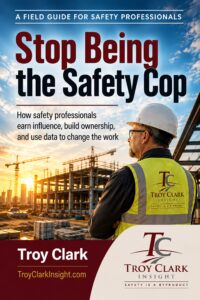
I wrote the book as a practical field guide to help safety professionals become more effective without taking over operations. It explores how to earn influence with operational leaders and apply professional judgment during disagreements and audits. The field tools and resources are designed to be used on the job.
For safety directors, the book can also serve as a professional-development resource for building teams that strengthen supervision rather than assuming its responsibilities.
Our job is to help operations succeed at managing safety, not to manage operations for them.
Stop Being the Safety Cop: A Field Guide for Safety Professionals is available on Amazon:
https://www.amazon.com/dp/B0HP6Y5DGP
Written by: Troy Clark
Keep Reading
55 Years In, We’re Still Figuring Out Safety
Read More
Next Step
Join the Community
Get notified when Troy's books launch, plus receive new Insights and occasional updates.