
OSHA Inspections: What Gets Cited and What Gets Missed
OSHA Inspections: What Gets Cited and What Gets Missed
An OSHA inspection can result in several citations and still fail to identify a condition that could seriously injure or kill someone. Throughout my career, I’ve personally witnessed OSHA compliance officers overlook violations they should have identified. I’ve also seen serious conditions that, in my professional judgment, warranted citations while officers concentrated on more obvious deficiencies. These experiences have led me to question the thoroughness of some inspections. I also believe OSHA leadership has a responsibility to ensure compliance officers have the training and support to conduct effective investigations.
What OSHA’s Top 10 Really Tells Us
Every year, OSHA publishes its most frequently cited standards. Fall protection consistently leads the list, while Hazard Communication and eye and face protection regularly appear among the top ten. OSHA’s preliminary fiscal year 2026 list places fall protection first, Hazard Communication second, and eye and face protection ninth. These rankings cover federal OSHA inspections across all industries, rather than construction alone.
These standards address genuine risks. According to the Bureau of Labor Statistics, 389 of the 1,034 fatalities in private-sector construction during 2024 resulted from falls, slips, and trips. Fall protection deserves serious attention. However, citation frequency tells us which standards were cited most often. The rankings provide little insight into the depth of an investigation or the conditions an officer may have overlooked.
When Fall Protection Looks Compliant but Isn’t
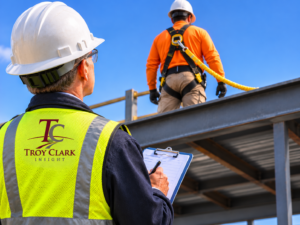 Consider an OSHA compliance officer visiting a construction site where several employees are working on a roof. Everyone is wearing a full-body harness and appears properly tied off. From the ground, the employees look protected, and the officer continues the inspection.
What hasn’t been established is whether the anchorages are appropriate for the application. They could be improperly installed or attached to structural components incapable of supporting the required loads. Employees who believe they’re protected could be relying on systems that would fail during a fall. Under 29 CFR 1926.502(d)(15), personal fall arrest anchorages must support at least 5,000 pounds per attached employee. Alternatively, they may be designed, installed, and used under the supervision of a qualified person as part of a complete system maintaining a safety factor of at least two.
An officer may need to examine the installation and supporting structure or review technical documentation before determining whether the employees are adequately protected. That investigation takes more effort than observing workers wearing harnesses, but overlooking an inadequate anchorage could have fatal consequences. I’ve personally encountered inadequate fall protection anchorages during my career, and I’ve witnessed OSHA compliance officers overlook violations that warranted further investigation.
Human Nature and the Path of Least Resistance
People tend to gravitate toward tasks they understand and can accomplish with confidence. Government employees, including OSHA compliance officers, are subject to the same tendencies as everyone else. Missing eye protection is relatively easy to recognize, and certain Hazard Communication deficiencies can be established by reviewing documentation. Determining whether a fall protection anchorage is structurally adequate may require considerably more investigation.
I believe some compliance officers concentrate on violations that are easier to identify rather than investing the effort necessary to investigate more complicated exposures. Many officers conduct thorough inspections, and my observations shouldn’t be interpreted as criticism of everyone working for OSHA. The tendency to favor familiar tasks is something OSHA leadership needs to account for when setting expectations for inspections.
Not Every Violation Deserves the Same Attention
After years of working in construction safety, I believe you could walk through almost any active construction site and identify something technically out of compliance. Conditions change constantly, making perfect compliance with every applicable requirement difficult to maintain. The seriousness of those violations can vary considerably. A technical deficiency with little relationship to employee safety deserves different consideration from an improperly installed fall protection anchorage that could fail under load.
OSHA’s enforcement procedures recognize a limited distinction through de minimis conditions. These are technical deviations that have no direct or immediate relationship to employee safety or health and do not result in citations. Other established violations generally remain subject to citation requirements under the Occupational Safety and Health Act. Compliance officers have an obligation to enforce applicable standards, while exercising professional judgment about where additional investigation is warranted.
OSHA Leadership Must Set the Expectations
OSHA’s Field Operations Manual provides procedures for conducting inspections and evaluating workplace conditions. However, written procedures cannot replace the technical competence and judgment required to recognize complicated hazards. OSHA leadership is responsible for ensuring compliance officers receive appropriate training and continued professional development. Supervisory reviews should determine whether officers adequately investigated serious exposures and recognized when technical assistance was necessary. The findings can help OSHA leadership address specific gaps in inspection practices.
Section 8(h) of the Occupational Safety and Health Act prohibits using citation totals or penalties to evaluate individual enforcement employees or establish enforcement-result quotas. This protects officers from being evaluated by the number of citations they write. The concern is whether OSHA leadership places sufficient emphasis on investigative quality alongside inspection and citation activity. Those measures are useful, but they cannot establish whether officers adequately examined the most serious conditions encountered.
Looking Beyond the Immediate Violation
Understanding why a hazardous condition exists may reveal problems extending beyond the immediate exposure. Consider the inadequate fall protection anchorage. Further investigation might establish that the employer never verified its suitability before installation. Perhaps responsibility for evaluating anchorages was never assigned, leaving supervisors to assume the system was acceptable.
These are possible explanations rather than findings from an actual investigation. They illustrate how a condition can develop through weaknesses in planning or supervision. Correcting the anchorage addresses the immediate hazard, while understanding how it was selected and installed can help prevent a similar problem from recurring. Employers remain responsible for providing safe working conditions.
What Changes After the Compliance Officer Leaves?
In my book, Stop Being the Safety Cop, I challenge safety professionals to evaluate their effectiveness by the changes they help create rather than the number of violations they identify. I believe OSHA leadership should apply that same philosophy when evaluating its enforcement program. An officer might issue ten citations during an inspection, and the employer may correct every cited condition. Yet the practices that allowed those conditions to develop could remain unchanged. An inspection that identifies a serious weakness in how work is planned or protective systems are evaluated could lead to broader improvements, even with fewer citations.
Citations remain necessary enforcement tools, particularly when employers expose workers to serious hazards. OSHA’s abatement verification rule requires employers to certify that cited conditions have been corrected. Correcting those conditions, however, doesn’t necessarily address the underlying problems that contributed to them.
OSHA leadership should examine whether enforcement activities produce improvements that continue after inspections are completed. Doing so requires looking beyond the initial citation report to what employers changed afterward. Compliance officers cannot guarantee how employers will respond to enforcement actions. The employer ultimately owns that responsibility. OSHA leadership, however, can establish expectations that encourage thorough investigations and provide officers with the support to meet them.
The purpose of enforcement should extend beyond documenting violations. We should judge the effectiveness of an OSHA inspection less by the number of citations written and more by what changes after the compliance officer leaves the jobsite.
Written by Troy Clark for TroyClarkInsight.com.
Keep Reading
You Can Buy Another Crane in Ninety Days. But Where Will You Find the Next Operator?
Read More
Next Step
Join the Community
Get notified when Troy's books launch, plus receive new Insights and occasional updates.